
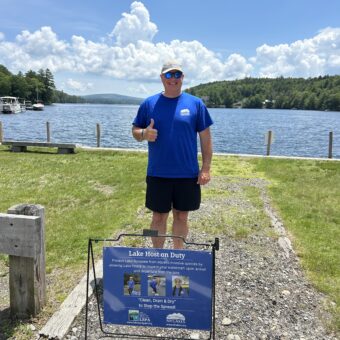
For John Webster, water has always been a part of life.
He’s spent decades working on and around the water—serving in the Coast Guard, operating ferries to Nantucket, managing MBTA ferries, and overseeing whale watch vessels in Boston Harbor. Today, in retirement, he still finds himself drawn to the water, but now his focus is protecting it as a Lake Host at Sunapee Harbor. Lake Hosts provide courtesy boat inspections through NH LAKES’ Lake Host Program, in partnership with the Lake Sunapee Protective Association.
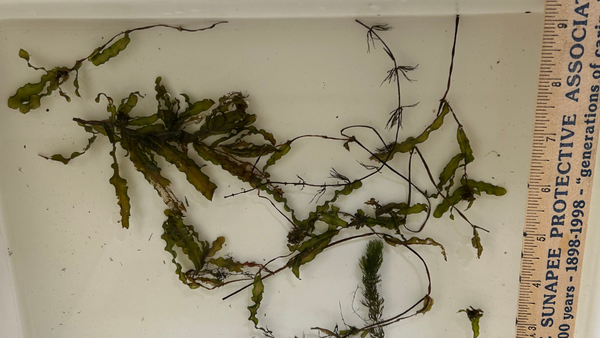
John is a first-year Lake Host who recently made an aquatic invasive species (AIS) “save” when he discovered and removed a fragment of curly-leaf pondweed from a boat arriving at the launch. It was a small piece of vegetation, but it serves as a powerful reminder that preventing invasive species often comes down to a single, careful boat inspection.
A Lifetime on the Water
Although John spent 37 years living on Cape Cod, New Hampshire’s lakes have always been part of his story.
“I’ve been boating and skiing here my whole life,” he said.
After years of visiting, John and his wife decided to retire to the Lake Sunapee region. Today, they live in Newport and spend much of their time enjoying the lakes they love.
Part of the appeal is the balance between activity and tranquility.
“There are several thousand seasonal boats, but it’s still a quiet lake,” he explained. “It’s big enough that you don’t feel crowded. It’s peaceful out there. It’s not a rat race.”
Inspired by the People Protecting the Lake
Long before becoming a Lake Host himself, John regularly encountered Lake Hosts while launching his own boat. The Lake Host on duty would conduct a courtesy inspection to help prevent the spread of invasive species from other lakes and share educational opportunities on the “Clean, Drain, and Dry” method.
“I would have my boat checked, and I thought, ‘Gee, when I’m retired, that would be a good gig.'”
What stood out wasn’t just the inspections—it was the people.
“The Lake Hosts I encountered clearly cared about what they were doing, and that has an impact on people.”
For someone who enjoys meeting people, being outdoors, and contributing to a cause he believes in, the role felt like a natural fit.
Understanding What’s at Stake
John was already familiar with invasive species issues from his years in the maritime industry and the Coast Guard.
“Back on the Cape, we have invasives in some of our bigger lakes,” he said. “From a marine point of view, they choke and clog vessels, ramps, and swimming areas.”
Those experiences reinforced his desire to help protect New Hampshire’s inland waters.
“To me, New Hampshire is so pristine, and I don’t want it getting ruined.”
A Save on His First Season
On June 3, while inspecting a fishing boat arriving at Lake Sunapee, John learned that the anglers had most recently been boating on the Connecticut River.
“As soon as they said they’d been somewhere other than Lake Sunapee, it heightened my awareness,” John recalled.
As he continued his inspection, something tucked between the trailer bunk and the hull of the vessel caught his eye.
“I saw a plant fragment and crawled underneath to get it out without ripping it apart.”
After carefully removing the specimen, John photographed it and shared it with Susie Burbidge, the Lake Host Coordinator for the Lake Sunapee Protective Association.
At first, he wasn’t certain what it was.
“I thought, ‘It kind of looks like curly-leaf pondweed, but better safe than sorry.'”
Recognizing the fragment could be an invasive species, Susie worked quickly to retrieve the sample from John and rehydrate it so its identifying features were more visible. Their quick action and attention to detail helped NH LAKES and New Hampshire Department of Environmental Services confirm the identification of curly-leaf pondweed, an invasive aquatic plant known for its rapid spread and disruption of lake ecosystems.
Fortunately, and thanks to John, it never made it into the lake.
“It was just one plant,” John said. “The rest of the boat was clean.”
But sometimes that’s all it takes. A single fragment of an invasive plant can be enough to start a new infestation in a lake.
Proof That Prevention Works
For John, the discovery underscored the real-world impact of the Lake Host Program and the important role inspectors play in preventing the spread of invasive species.
“It made me realize this is for real,” he said. “This isn’t just going through the motions.”
“One person can make a save and help stem the tide of invasives, little by little.”
The experience also reinforced the importance of educating boaters. Most people, he says, want to do the right thing.
“There are people who don’t care, but there are a lot of people who really do care. They just might not know something got caught on their trailer.”
John makes a point of talking with anglers about threats like spiny water flea and other invasive species.
“I tell them, ‘This is going to affect your fishing if you don’t help keep an eye out for it.’ Ninety-nine percent of people are super responsive. They love to fish here, and they don’t want these invasives.” This is backed by NH LAKES historical data as well: approximately 95% of inspected boaters are familiar with the Lake Host Program and the “Clean, Drain, and Dry” method for preventing the spread of aquatic invasive species.
What Can We All Do?
When asked what the average person can do to help protect their favorite lake, John’s answer is simple:
“Be aware of invasive species and clean your boats.”
Taking personal responsibility to inspect our boats, trailers, and equipment before entering and leaving a waterbody remains one of the most effective ways to prevent the spread of aquatic invasive species.
John also believes education is key.
“I’d love to see more outreach to schools and young people. If you can make an impact on the kids, it’ll make an impact on their parents.”
After a lifetime on the water, protecting it remains deeply personal.
“Everything to do with the water is near and dear to my heart,” John said. “Whether it’s a lake or the ocean, you don’t want it to be garbage. You want it to be healthy. We have to maintain the ecology.”
Thanks to vigilant Lake Hosts like John, dedicated local coordinators like Susie, and the boaters who take prevention seriously, New Hampshire’s lakes have a better chance of staying healthy for generations to come.
- Become a hero like John for your lake! Learn more about the Lake Host Program, and become a paid or volunteer Lake Host.