

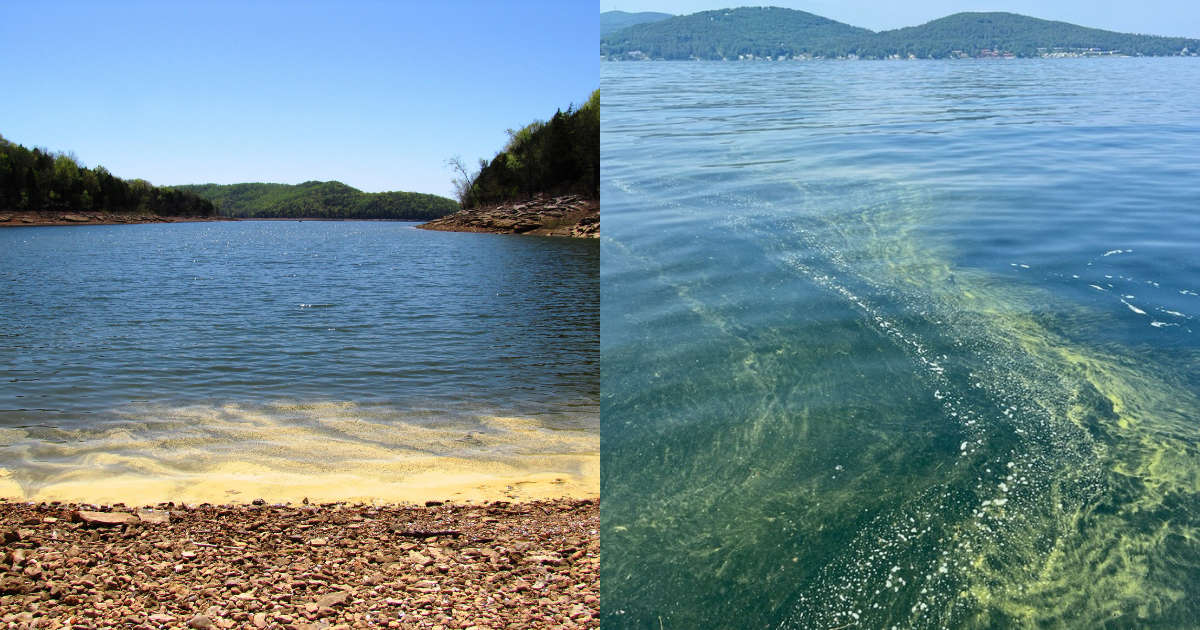
Every spring, as trees begin releasing pollen across New Hampshire, our phones start ringing, and emails start pouring in from people at lakes across the state asking:
“What’s floating on my lake? Is it cyanobacteria?!”
It’s an understandable concern. Both pollen and cyanobacteria can create colorful surface films on lakes and ponds, and from a distance, they can look surprisingly alike. But knowing how to tell them apart is important, since cyanobacteria blooms can pose risks to people, pets, and lake health, while pollen is a natural and generally harmless part of the spring season.
First: Check for Existing Cyanobacteria Alerts
Before trying to identify a suspicious surface film yourself, it’s always a good idea to see if someone has already reported a bloom on your waterbody.
The New Hampshire Department of Environmental Services maintains the NH Healthy Swimming Mapper, which provides current cyanobacteria advisories and reports across the state.
If a cyanobacteria alert is already in place, you should avoid contact with the water and follow all public health guidance.
When in Doubt, Stay Out
If you notice anything unusual on the water’s surface and aren’t sure what it is, avoid contact and report it to the New Hampshire Department of Environmental Services.
Avoiding contact is especially important for children and pets, who are more vulnerable to cyanobacteria toxins.
How to Tell the Difference
It can sometimes be tricky to tell pollen and cyanobacteria apart, but there are a few easy signs that can help.
Pollen
Pollen is common in the spring and is generally harmless in the water.
Pollen often:
- Looks like yellow-green dust or a thin film on the surface
- Forms streaks or patches that collect along shorelines
- Stays floating on top of the water
- Appears during the spring pollen season (like right now in New Hampshire!)
Wind can easily move pollen around, causing it to gather in coves or calm areas of a lake.
Cyanobacteria
Cyanobacteria blooms can look very different depending on conditions and the species involved.
Blooms may:
- Look like bright green paint, pea soup, cloudy water, or floating clumps
- Collect along shorelines or in coves
- Mix throughout the water column instead of staying only on the surface
- Move up and down in the water depending on sunlight and nutrients
- Occur most often in mid-to-late summer, though blooms can appear earlier in warmer or smaller ponds
Why Cyanobacteria Matters
Cyanobacteria are naturally present in lakes and ponds, but under the right conditions—especially warm temperatures, calm water, and excess nutrient pollution—they can multiply rapidly and form blooms.
Some blooms can produce toxins that are harmful to people, pets, and wildlife.
One key thing to know is that you cannot tell whether a bloom is toxic just by looking at it.
Laboratory testing is required to determine whether toxins are present. That’s why, whenever you see what might be a cyanobacteria bloom, it’s safest to assume it is dangerous.
What to Do If You Suspect a Bloom
If you see a possible cyanobacteria bloom:
Do not swim, wade, or drink the water.
- Keep children and pets away.
- Rinse off with clean water immediately if contact occurs.
- Take photos and report it as soon as possible.
Conditions can change quickly, and timely reports help protect others using the waterbody.
Working Together to Protect Our Lakes
Early reporting of possible cyanobacteria blooms is important for keeping New Hampshire’s lakes safe and healthy for everyone. Whenever you’re swimming, paddling, fishing, or simply enjoying the shoreline, staying informed helps protect both people and aquatic ecosystems.
Learn more about cyanobacteria, bloom reporting, and lake health.